

On this page
Preview Summary
The best place for a kitchen trash can is usually close to where you prepare food, but an island or cabinet can change what fits. A bin beside an island should be easy to reach without blocking drawers or seating. A sliding cabinet model keeps trash hidden but needs enough room for rails, installation, and changing liners. A smaller hanging compost bin offers another option for food scraps: it can attach to the inside or outside of a cabinet door without a sliding base. This guide compares the three setups, explains what to measure, and helps you choose a bin that suits the way you cook and clean up.
Quick Answer
For a kitchen island, a rectangular step or sensor trash can works beside the cabinetry if it leaves room for drawers, seating, and the open lid. If you want your main trash and recycling hidden, a sliding cabinet bin may be a better fit, provided the cabinet has enough space for the rails and inner liners. For food scraps, a compact hanging compost bin can attach to the inside or outside of a cabinet door without a sliding base. Choose based on what you throw away, how often you use the bin, and the space available.
Where Should You Place Your Trash Can in an Island Kitchen?
There are three useful options: a main trash can beside the island, a larger sliding bin inside a cabinet, or a small compost bin hanging on a cabinet door. Each serves a different purpose. Your choice depends on what you throw away, how you cook, and how much storage space you can spare.
|
Location
|
Main advantage
|
What to check
|
|
Beside the island
|
Easy access without installation
|
Lid clearance, drawers, seating, and walking room
|
|
Inside an island cabinet
|
Trash stays hidden behind a door
|
Usable cabinet dimensions and sliding clearance
|
|
On a cabinet door
|
Keeps a small compost bin close to food prep
|
Door clearance and space inside or outside the cabinet
|
|
Under a nearby counter
|
Close to food prep and the sink
|
Plumbing, hinges, and cabinet hardware
|
|
Pantry or utility area
|
Keeps waste away from busy prep areas
|
Whether the location is convenient during cooking
|
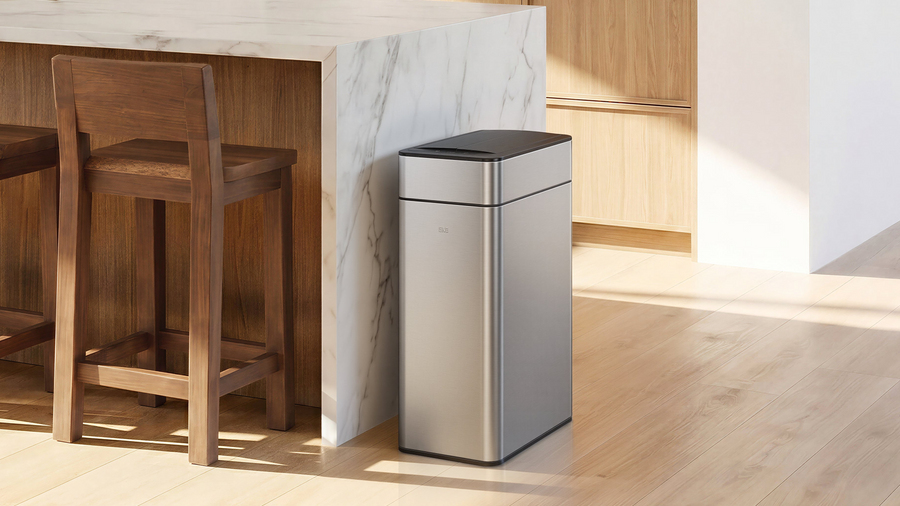
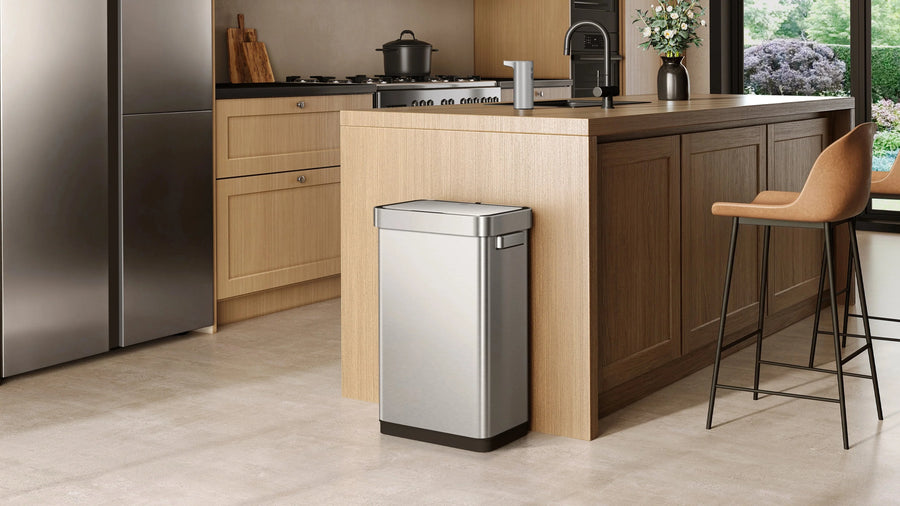
If you prepare most meals at the island, keep your main trash can nearby for packaging and everyday waste. A cabinet-mounted unit keeps larger bins behind a door. For fruit peels and vegetable scraps, a hanging compost bin can be close to the prep area and easy to empty.
Best Trash Cans to Place Beside a Kitchen Island
Choose a Shape That Fits Along the Island
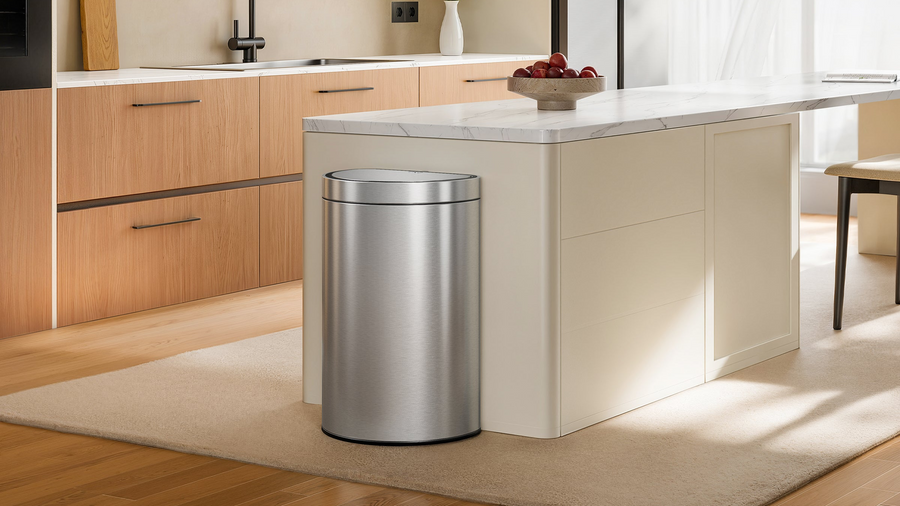
A rectangular bin can sit against a flat island panel. That is often easier to arrange than a round bin in the same location, especially when stools, cabinet doors, or drawers are nearby. Check the width and depth of the bin itself rather than judging from product photos. If the island has an overhang for seating, do not assume the space underneath will be comfortable for a trash can.
Step Trash Cans: Convenient When Your Hands Are Full
A step can opens when you press the pedal with your foot. It is a good choice if you want hands-free use without batteries. Make sure you can reach the pedal naturally from the prep area and have enough space to open the lid. Soft-close lids are useful in kitchens where the bin is opened frequently.
Sensor Trash Cans: Touchless Disposal During Cooking
A sensor can opens when it detects movement near the sensor, so you can throw away scraps without touching the lid. This is particularly convenient when your hands are wet or messy. Look for a model with a stay-open function if you often peel vegetables or clear several plates at once. EKO sensor models use batteries, so follow the battery requirements in the product instructions.
Consider Where the Lid Opens
A lid that rises above the bin needs enough clearance under countertops or overhangs. Some models use split or dual-wing lids, which may suit spaces with less height above the bin. Always check the listed open height for the exact model. The closed height alone will not tell you whether the lid can open comfortably.
Best Trash Cans for Inside Kitchen Cabinets
What Is a Pull-Out Trash Can?
A sliding cabinet trash can sits on a rail-mounted base inside a cabinet. When you open the cabinet and pull the unit forward, the bins move out so you can throw away waste or change the bags. It is a good option when you want to keep trash out of sight and free up floor space. Unlike a bin beside the island, a pull-out model needs installation and a suitable cabinet.
Measure the Usable Space Inside the Cabinet
Measure the clear width, depth, and height inside the cabinet. Then check whether hinges, plumbing, shelves, and other fittings reduce the space available. A cabinet may have enough overall width but still be too narrow where the sliding unit needs to sit. Check the manufacturer’s minimum cabinet dimensions rather than relying on the cabinet’s advertised size.
For example, EKO’s 58L Deco Duo Plus cabinet bin has two compartments of 34L and 24L. The product information specifies a minimum cabinet interior of 36.9 cm wide, 56 cm deep, and 61 cm high. The unit itself measures 31.9 cm wide, 52.8 cm deep, and 56.5 cm high. Use the current product instructions to confirm fit and installation requirements before purchase.
Check How Far the Unit Slides Out
There should be enough room in front of the cabinet to pull the bins forward and remove the inner liners. Check whether an opposite island, dishwasher door, or nearby appliance will interfere. If the cabinet is in a tight aisle, open the surrounding doors and drawers while measuring. That gives you a better idea of how the setup will work during meal prep and cleanup.
Plan for Installation and Future Cleaning
Some cabinet units attach to the cabinet floor with screws. Follow the installation instructions for the exact model, including the recommended tools and screw locations. Before drilling, confirm that the cabinet floor is suitable and that the unit is aligned with the opening. Removable inner liners are useful because you can lift them out to empty and wash them without removing the sliding base.
A Hanging Compost Bin for Cabinet Doors
A compact compost bin is another option if you mainly need a place for food scraps while preparing meals. The EKO 7L / 1.85 Gal Stainless Steel Kitchen Compost Bin can hang on the inside or outside of a cabinet door. You can keep it near the sink or prep area without using the cabinet floor or installing sliding rails.
Unlike a larger sliding cabinet trash can, this 7L model is designed for smaller amounts of food waste, such as fruit peels and vegetable trimmings. It has a removable inner liner for emptying and cleaning, plus a deodorizer compartment. It can also be used on a countertop, but hanging it on a cabinet door is especially useful when counter space is limited.
If you hang it inside the door, check that shelves, plumbing, and other items leave enough room for the door to close. If you hang it on the outside, choose a door where the bin will not get in the way of drawers or people moving through the kitchen.
Single or Dual-Compartment Trash Can?
A single-compartment model may be enough if you already have a separate recycling container elsewhere. A dual-compartment trash can gives trash and recycling their own spaces in one unit. This can be useful beside an island or inside a cabinet, especially if you sort packaging while cooking. Check the capacity of each compartment: a 58L unit with 34L and 24L sections does not provide 58L for general trash alone.
Before deciding, think about which type of waste fills up first. Households that recycle a lot of cardboard, cans, and plastic packaging may prefer a larger recycling compartment. If food scraps are collected separately, consider where a small compost container will sit. Local recycling rules vary, so follow your collection provider’s guidance about what belongs in each bin.
Kitchen Island vs. Cabinet Trash Can: Which Is Easier to Live With?
|
Everyday task
|
Beside the island
|
Inside a cabinet
|
Hanging on a cabinet door
|
|
Throwing away scraps
|
Bin is visible and easy to reach
|
Open cabinet and pull unit forward
|
Open lid and add small food scraps
|
|
Changing bags
|
Usually direct access from the top
|
Slide out and lift out inner liner if required
|
Remove inner liner for emptying
|
|
Cleaning around the bin
|
Move bin and clean floor
|
Clean inner liners and accessible cabinet area
|
Clean inner liner and door area
|
|
Installation
|
Usually none
|
May require drilling and assembly
|
No sliding rails required
|
|
Keeping waste out of sight
|
Depends on lid and placement
|
Hidden when cabinet door is closed
|
Visible outside; concealed inside
|
A sliding cabinet bin can keep everyday trash and recycling behind a door, but it takes up cabinet storage space. A hanging compost bin uses the cabinet door instead and works best for smaller amounts of food scraps. Both can keep the floor clear. A main trash can beside the island remains convenient when you need a larger bin within easy reach.
How to Choose a Bin for Your Kitchen Layout
Small Kitchens and Narrow Aisles
In a narrow kitchen, check whether the bin will interfere with cabinet doors, appliance doors, or people moving past. A slim rectangular model can fit beside cabinetry where a wide round bin would be awkward. For an inside-cabinet unit, measure the space available for the rails and inner liners. For a small hanging compost bin, check the cabinet door and surrounding clearance instead.
Large Kitchens With an Island
In a larger kitchen, place the main bin near the area where you prepare and clear food. A step or sensor model beside the island is easy to reach. If you prefer to use cabinet space, a sliding unit can hold everyday trash and recycling, while a hanging compost bin can collect food scraps on the inside or outside of a cabinet door. Keep both cabinet options away from areas where open doors would interrupt cooking.
Islands With Seating
Avoid placing the bin where stools slide back or where people rest their feet. If the island has cabinets on one side and seating on the other, the cabinet side is often easier to use. Check that the lid opens fully and that the bin does not prevent drawers or doors from opening.
Sink Cabinets
Under-sink storage can be convenient because food prep and cleanup often happen nearby. For a sliding cabinet bin, measure around pipes, disposal units, and cleaning supplies, and check that the unit can extend fully. For a hanging compost bin, check that the cabinet door closes properly with the bin attached on the inside, or that it will not obstruct movement when hung outside.
Common Mistakes to Avoid
-
Buying a cabinet unit based only on the cabinet’s outside dimensions.
-
Checking the bin’s closed height but not the height with the lid open.
-
Placing a bin beside stools or drawers that need room to open.
-
Assuming the total capacity of a dual-bin unit is available for general trash.
-
Installing a sliding base before checking that the bins can be removed for cleaning.
-
Choosing a location that is difficult to reach when cooking or clearing the table.
EKO Options to Consider
For a bin beside the island, EKO offers step and sensor models in rectangular designs, including the 50L Mirage-T sensor can and Hudson step-can range. Compare the exact dimensions, lid-open height, and features before choosing. For concealed storage, the EKO 58L Deco Duo Plus cabinet bin provides separate 34L and 24L inner liners. These examples serve different layouts, so the better choice depends on the space available and how you prefer to dispose of waste.
For food scraps, consider the EKO 7L / 1.85 Gal Stainless Steel Kitchen Compost Bin. It can hang inside or outside a cabinet door, with a removable inner liner and a deodorizer compartment. This is a different solution from the 58L Deco Duo Plus, which uses sliding rails and offers larger compartments for everyday trash and recycling.
Find a Trash Can That Fits Your Kitchen
A bin beside the island offers quick access during cooking. For cabinet storage, a sliding model holds larger amounts of everyday trash and recycling, while a hanging compost bin keeps smaller food scraps close to your prep area. Compare the available space, how each bin opens, and how easy it will be to change liners and clean the bin.
For a broader comparison of sizes, lids, and materials, see the pillar guide “Best Kitchen Trash Cans (2026 Buying Guide)”.
Related reading: “Trash Can Placement Ideas for Small and Large Kitchens” and “What Size Trash Can Do I Need for My Kitchen?”.
Sources and Further Reading
EKO USA Trash & Recycling collection — https://ekousa.com/collections/trash-recycling
U.S. Environmental Protection Agency, Frequent Questions on Recycling — https://www.epa.gov/recycle/frequent-questions-recycling
EKO 7L Stainless Steel Kitchen Compost Bin — verify current mounting options and product details on the EKO USA product page.
EKO 58L Deco Duo Plus installation guide and product specifications — consult the current product manual before installation.