

On this page
Preview Summary
Where you put your kitchen trash can matters just as much as which model you choose. A bin that looks great online can feel awkward if the lid hits a counter, the pedal is hard to reach, or the container blocks a cabinet door. This guide walks through practical placement ideas for small kitchens, spacious layouts, kitchen islands, and shared cooking areas. You will learn how to keep trash close to food prep without putting it in the way, when a slim or rectangular can is useful, and what to measure before buying. We also cover recycling, pets, cleaning, and a few common placement mistakes. The goal is a kitchen that feels easy to use every day, not a bin tucked into an inconvenient corner.
Quick Answer
The best place for a kitchen trash can is usually near your main food-prep or cleanup area, where you can reach it without blocking cabinets or the space you use to move around the kitchen. In a small kitchen, look for a narrow spot beside a cabinet, at the end of a counter, or along an open wall. In a larger kitchen, place the main bin near the island or sink, then decide whether recycling belongs beside it or closer to where you unpack groceries. Before buying, measure the available width and depth and confirm that the lid and pedal can be used comfortably.
Start With the Tasks You Do Most Often
Think about where waste actually collects. Vegetable peels and food packaging often end up near a cutting board. Paper towels and dishwashing waste tend to collect near the sink. Empty cartons may pile up where groceries are unpacked. Keep the bin close to where you prepare food so you can throw away scraps as you cook.
Spend a day noticing where you walk with scraps or wrappers in your hands. If you regularly cross the room to reach the bin, the current location may not be working. A trash can should be easy to reach, but it should not interfere with opening the dishwasher, pulling out a drawer, or moving between the stove and sink.
Placement Ideas for Small Kitchens
Beside the end of a cabinet run
A narrow gap at the end of your lower cabinets can be a useful location for a slim bin. Look for a model that fits within the available width and leaves room for the lid to open. A rectangular body may sit closer to the cabinet than a round can of similar capacity.
Against a clear wall
If there is no space beside the counter, use a section of wall near your prep area. Keep enough room to pass comfortably and avoid placing the bin where an open refrigerator or oven door will hit it. A flat-backed or rectangular design can sit neatly against the wall.
Near the sink, but not in front of the dishwasher
The sink is a convenient place for everyday cleanup, especially if you frequently scrape plates or throw away used paper towels. Check what happens when the dishwasher door is fully open. A bin that fits while everything is closed may become an obstacle during cleanup.
Inside a cabinet, when space allows
An under-counter or pull-out bin keeps waste out of sight and frees up floor space. Check the cabinet’s interior width, depth, and height, along with plumbing, hinges, and any pull-out hardware. This option works best when the bin can be reached without rearranging cleaning supplies every time you need it.
Placement Ideas for Larger Kitchens
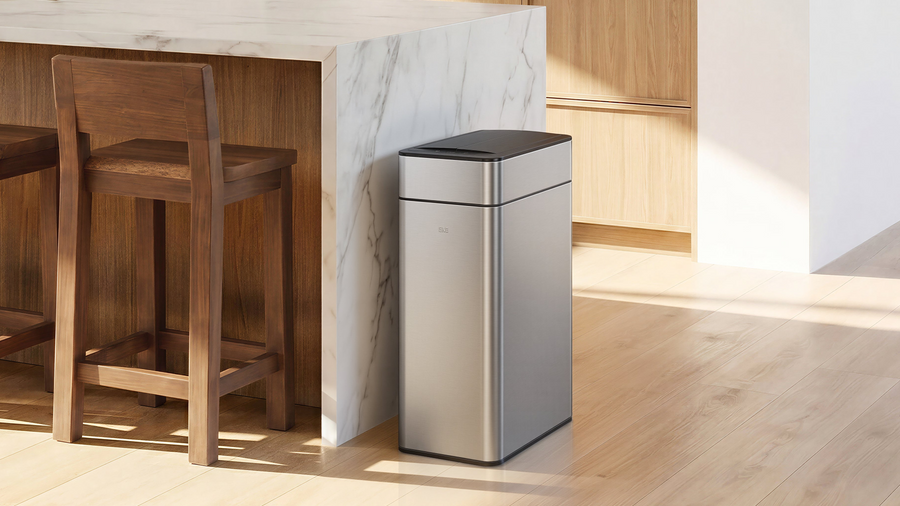
Beside a kitchen island
An island often becomes the main place for chopping, meal prep, and serving. A bin beside the island can make cleanup quicker. Choose the side that is easiest to reach from your work area, rather than the side facing the busiest part of the room. Check that stools and cabinet doors still have enough clearance.
Near the main prep counter
In a larger kitchen, the nearest wall may be too far from the area where you cook. Place the bin near your main prep area so you can easily throw away food scraps while cooking. If you have a sensor can, consider whether people walking past might trigger the lid; follow the product’s sensor placement guidance.
In a pantry or utility area
A pantry can work for bulky packaging or a recycling bin, particularly if it is close to where you unpack groceries. It is usually less convenient for food scraps generated while cooking. If the pantry is far from the sink and counter, you may prefer to keep everyday trash in the kitchen.
Near the kitchen exit
If you regularly carry full bags outside, a spot near the exit may make bag changes easier. That benefit matters most when the location is still convenient for daily use. Avoid making every small cleanup task a walk to the door.
How to Choose a Spot: A Quick Comparison
|
Location
|
Works well when
|
Check before placing
|
|
Beside cabinets
|
You need a slim, easy-to-reach location
|
Drawer and lid clearance
|
|
Near the sink
|
Most waste comes from washing up
|
Dishwasher door clearance
|
|
Beside an island
|
You prep and serve food at the island
|
Seating and walking room
|
|
Inside a cabinet
|
You want waste out of sight
|
Interior dimensions and hardware
|
|
Pantry or utility room
|
You store packaging or recycling there
|
Distance from daily food prep
|
Check the Space Needed to Open the Lid
Width and depth tell you whether the bin fits in a gap, but they do not tell you whether you can use it comfortably. Measure the height with the lid fully open, especially beneath a countertop or shelf. Check that a step pedal has enough room for your foot and that you can lift out the inner liner or remove a full bag without moving nearby furniture.
Open the closest cabinet, drawer, dishwasher, and refrigerator doors while testing the spot. If any of them touch the bin or make it difficult to reach, try another location. Leave enough room to wipe the floor and the sides of the can. For a more detailed guide to capacity and dimensions, see “What Size Trash Can Do I Need for My Kitchen?”.
Where Should Recycling Go?
Recycling is easiest to keep up with when the container is near the place where bottles, cans, and packaging are emptied. For some households, that means next to the main trash can. For others, a recycling bin near the pantry or grocery-unpacking counter makes more sense.
A dual-compartment trash can keeps trash and recycling in one container. Check the capacity of each compartment rather than only the total capacity: one compartment may fill up faster than the other. Follow your local recycling program’s instructions on what belongs in the recycling compartment. The U.S. Environmental Protection Agency notes that accepted materials vary by community.
Should You Keep the Trash Can Hidden?
A bin tucked inside a cabinet can keep the kitchen neat and organized, but it may be less convenient to reach. If opening a cabinet becomes an extra step every time you discard food scraps, a bin beside your prep counter may be easier to use. If you choose a cabinet installation, make sure there is enough room to remove the bin and change the bag.
A stainless steel bin can coordinate with appliances, while a plastic or resin model may be easier to move for cleaning. Appearance matters, but daily access and easy bag changes should come first.
Placement Tips for Step and Sensor Cans
Step cans
Make sure you have enough room to step on the pedal comfortably. Place it where you can step comfortably without twisting around an island, stool, or cabinet door. Test the lid at full height before committing to a location beneath a counter.
Sensor cans
A sensor can opens when it detects motion near the sensor, which is useful when your hands are messy during food prep. Place it where you can approach naturally and dispose of scraps without touching the lid. Avoid spots where passing traffic may trigger the sensor repeatedly, and check the specific model’s detection range and battery instructions.
For a closer comparison of these designs, read “Step Can vs. Sensor Can vs. Swing Lid: Which Is Right for You?”.
Consider Kids, Pets, and Cleaning
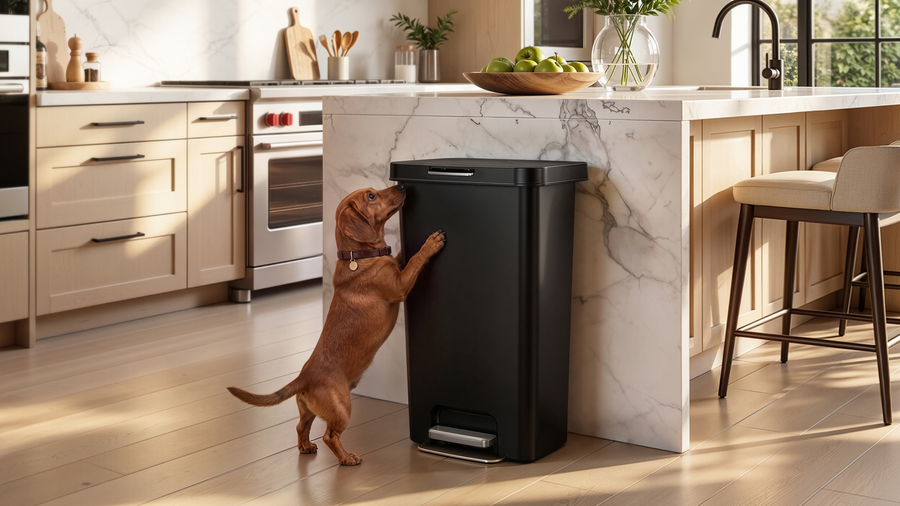
In a busy household, a bin beside a play area or pet feeding station may be bumped more often. A stable base and a location away from the busiest route can help. If you have curious pets, think about whether they can reach the lid or knock the bin over; no ordinary kitchen bin should be assumed to be pet-proof.
Keep the bin away from direct heat and avoid placing it where spills collect underneath. You should be able to wipe the surrounding floor and clean the lid without moving heavy furniture. If the bin sits beside a wall, leave enough access to clean behind it from time to time.
Common Placement Mistakes
-
Choosing a gap based only on the bin’s closed dimensions.
-
Placing the bin where it blocks the dishwasher or a frequently used drawer.
-
Placing a pedal can where there is no comfortable room to step.
-
Keeping everyday trash so far from the prep counter that scraps get carried across the room.
-
Forgetting how the full bag will be removed and carried out.
-
Assuming one large bin is always more convenient than separate trash and recycling locations.
Kitchen Trash Cans to Consider
Once you know where the bin will sit, choose a shape and capacity that suit that location. A slim EKO step can may be useful beside cabinets or in a narrow kitchen. A rectangular sensor can can work near a main prep counter when touchless disposal is a priority. If you want trash and recycling together, look at EKO dual-compartment options and compare the individual compartment sizes.
Browse current models and check each product page for exact dimensions, lid-open height, and features: https://ekousa.com/collections/trash-recycling. For a broader buying overview, see “Best Kitchen Trash Cans (2026 Buying Guide)”
Where Should You Put Your Kitchen Trash Can?
The best spot is usually close to where you prepare food, with enough room to open the lid and change the bag comfortably. In smaller kitchens, a slim rectangular bin can fit neatly beside cabinets. Larger kitchens offer more flexibility, but keeping the bin near your main prep area still makes everyday cleanup easier.
Sources
U.S. Environmental Protection Agency, Frequent Questions on Recycling: https://www.epa.gov/recycle/frequent-questions-recycling
EKO USA, Trash & Recycling collection: https://ekousa.com/collections/trash-recycling